



Be honest. Most of us think about endless lunges the moment we think about building sculpted glutes. Your mind probably jumps straight to heavy barbell hip thrusts and sweaty squat racks. But what if we told you that your yoga mat is actually one of the most underrated tools for building a powerful posterior chain?
This International Yoga Day 2026, work on a toned physique.
Yoga Day is celebrated on 21st July every year.
You can get rid of the office-chair-flat-butt with the right yoga asanas for strong glutes. This blog is a good read for anyone who thinks yoga cannot leave you sweating as much as the gym. Whether you are an active runner looking to stabilize your glutes or a fitness enthusiast working on active aging.
International Yoga Day and Longevity
Beyond aesthetic reasons, cultivating strong glutes actually helps in injury prevention. With International Yoga Day 2026 just around the corner, there is no better time to set up the home workout space for your practice. Why? Because the longest day of the year is approaching on International Yoga Day, 21st July 2026. It is the summer solstice. This time is considered best to begin workout routines, especially yoga, because this celestial arrangement allows you to harness the sun’s life-giving power. It is beneficial for yoga and exercise because it features the longest daylight hours of the year.
Beginning yoga routines starting on the summer solstice symbolizes a peak in:
- Vitality
- Illumination
- Strength
- Natural energy
This year, the International Yoga Day 2026 theme centers heavily on sustainable, lifelong wellness. That is the reason why it is even more important to discuss why you need to build functional strength. More importantly, why is yoga the right choice for building strong glutes? In this guide, we are diving into the best yoga asanas to wake up, fire up, and strengthen your glutes while keeping your joints safe and your performance high.
Why Strong Glutes Are Your Ultimate Longevity Insurance
Before we unroll the mat, let’s talk science.
Your glutes are made up of three muscle groups:
- gluteus maximus
- gluteus medius
- gluteus minimus
Together, they form the largest muscle group in your body.
Hmm, sounds pretty cool, doesn't it?
No. Unfortunately, our modern lifestyle is a glute-killer. Hours of sitting cause our hip flexors to tighten and our glutes to go dormant in daily activity. They literally "go to sleep." This is a phenomenon physical therapists call reciprocal inhibition, or glute amnesia.
So what happens when your glutes turn off? Your lower back, knees, and hamstrings have to pick up the slack. This leads to chronic lower back pain, poor posture, and knee instability. This is why integrating a targeted yoga exercise routine into your weekly schedule is an investment in your longevity. Building strong glutes with yoga helps to stabilize your pelvis, protect your lower back, and ensure you keep moving fluidly, powerfully, and pain-free as you age.
5 Powerful Yoga Poses for Glute Strength and Stability
To get the most out of these poses, focus on mindful muscle engagement. Don't just hold the shape. Actively squeeze, press, and stabilize your core and leg muscles. This is on the list of the most common yoga mistakes people make during yoga exercises for the glutes at home. Here are five powerhouse asanas to add to your routine. Here’s how to do them the right way.
Warrior III (Virabhadrasana III)
Target: Gluteus medius (side glutes) and ankle stabilizers.
Warrior III is the ultimate test of single-leg balance and isometric strength. Because you are balancing on one leg, your gluteus medius has to work overtime to keep your pelvis level. Here are the steps on how to do the Warrior III Yoga Pose for stronger glutes.
- Start at the top of your mat in Mountain Pose.
- Shift your weight onto your right foot.
- Slowly hinge at your hips, sending your torso forward while reaching your left leg straight back behind you.
- Keep your hips square to the floor (don't let your left hip turn upward). Your body should form a "T" shape.
- Flex your back foot actively, as if pressing it against a wall.
- Hold for 5 deep breaths, then switch sides.
|
Stoga Pro-Tip If your standing ankle feels unstable, practice this on a high-grip, high-density ergonomic mat. Standard squishy mats can strain your joints, but a firm, supportive surface ensures your standing glute does the stabilizing work—not your tendons. |
Chair Pose (Utkatasana)
Target: Gluteus maximus, quadriceps, and core.
The Chair Pose yoga asana will fire up your thighs, core, glutes, and ankles. It is essentially yoga’s version of a deep, held squat. It builds incredible endurance in the lower body and fires up the posterior chain instantly. Here is how to do the chair pose the right way.
- Stand with your feet together or hip-width apart.
- Inhale and reach your arms up overhead, keeping your shoulders relaxed.
- Exhale as you bend your knees and sink your hips back and down, as if sitting in an invisible chair.
- Shift your weight back into your heels. You should be able to wiggle your toes.
- Tuck your tailbone slightly to keep your lower back from over-arching.
- Hold for 5 to 10 breaths, sinking a little deeper with every exhale.
Bridge Pose (Setu Bandha Sarvangasana)
Target: Gluteus maximus and hamstrings.
If you want to isolate the glutes without putting stress on your knees or lower back, the bridge pose is your go-to. It allows you to focus purely on hip extension. Here’s how to do the Bridge Pose for stronger glutes.
- Lie on your back with your knees bent and feet flat on the floor, hip-width apart. Your heels should be close enough to your glutes. You should be able to graze them with your fingertips.
- Press down firmly through your feet and arms.
- Inhale as you lift your hips toward the ceiling.
- Keep your thighs parallel, but don't let your knees splay outward.
- Roll your shoulders underneath you and clasp your hands if accessible.
- If you want to maximize glute activation, imagine dragging your heels backward toward your shoulders without actually moving them. Aha, that!
- Hold for 8–10 breaths, then slowly roll down one vertebra at a time.
The Goddess Pose (Utkata Konasana)
Target: Glutes, inner thighs, and hip external rotators.
The rotator muscles are one of the most important and functional muscles that prevent injuries. The Goddess Pose is a lateral powerhouse. It strengthens the glutes in an externally rotated position, which is fantastic for hip mobility and lower-body power. Here’s how to do the Goddess Pose for stronger glutes.
- Step your feet wide apart on your mat, turning your toes out at a 45-degree angle.
- Inhale and reach your arms out to the sides.
- Exhale as you bend your knees, lowering your hips down until your thighs are parallel to the floor (or as close as comfortable).
- Keep your knees tracking directly over your middle toes—don't let them collapse inward.
- Keep your spine upright and your core engaged.
- Hold for 5–8 breaths. For an extra challenge, try lifting your heels off the floor one at a time.
High Lunge (Ashta Chandrasana)
Target: Gluteus maximus (of the front leg) and hip flexors (of the back leg).
High Lunge is a dynamic posture that builds explosive lower-body strength while simultaneously stretching the hip flexors of your back leg—a perfect antidote to sitting. Take a look at the steps below to learn how to build strong glutes at home:
- From Downward-Facing Dog, step your right foot forward between your hands.
- Ensure your right knee is stacked directly over your right ankle at a 90-degree angle.
- Inhale as you lift your torso upright, reaching your arms toward the sky.
- Press your back (left) heel toward the back of the room, keeping that leg active and straight.
- Press down firmly through your front heel to fully engage your right glute.
- Hold for 5 breaths, then step back and switch sides.
Upgrade Your Yoga Flow and Performance
Yoga is incredibly effective, but only if your alignment is correct. When you are working on glute activation, stability is everything. If your mat is too slippery or too thin, your joints will end up overcompensating, which shifts the work away from your muscles and onto your ligaments.
|
Product / Mat |
Effect on Joints |
Outcome / Risk |
|
Thin and Slippery Mat |
Joint instability |
Ligament strain (High risk) |
|
Stoga Ergonomic Mat |
Joint alignment |
Deep muscle activation (Safe & effective) |
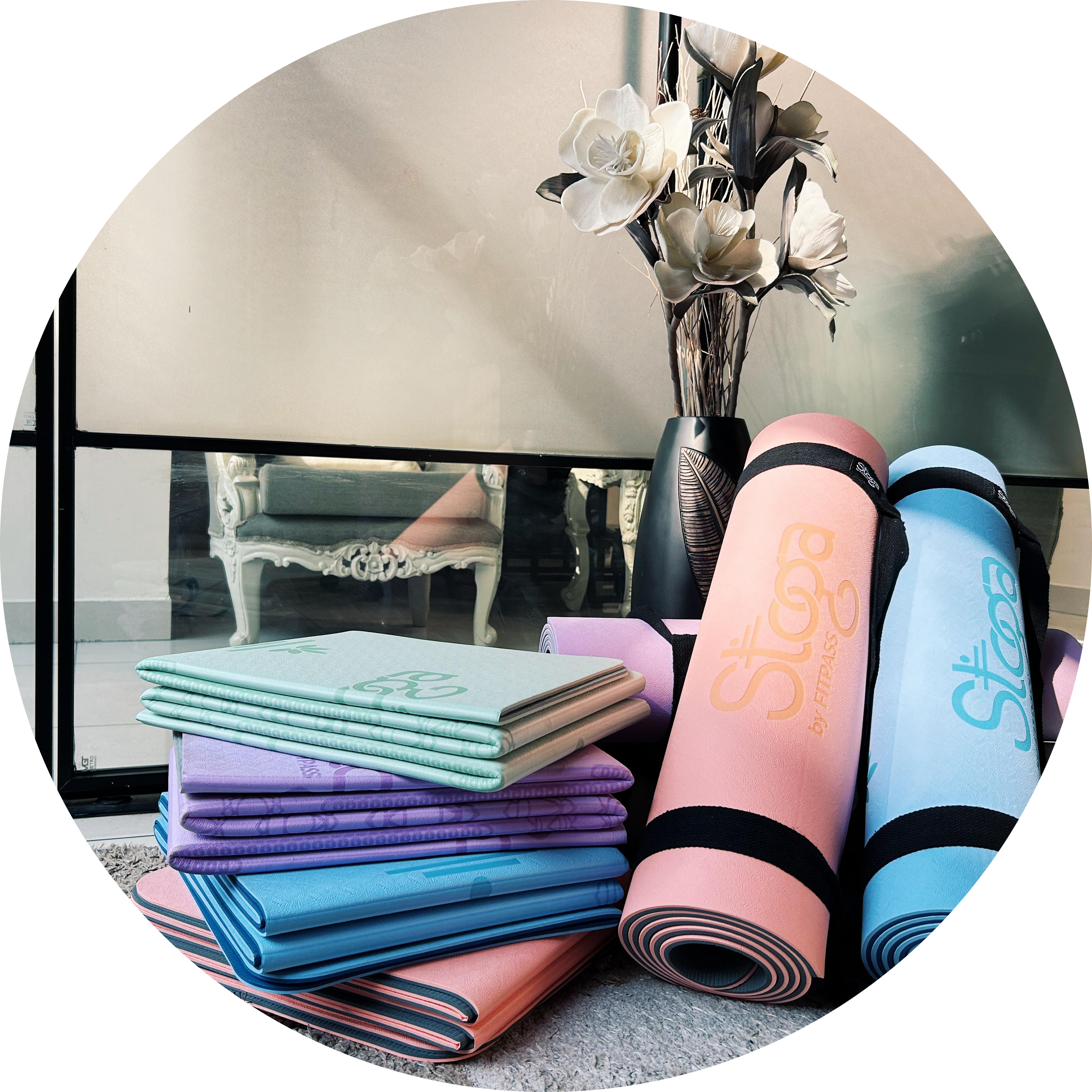
At Stoga, we design home workout gear that bridges the gap between high performance and joint safety. Our functional and durable yoga mats provide the perfect balance of high-density cushioning to protect your knees in Bridge Pose. It offers a non-slip grip that keeps you rock-solid during Warrior III.
Worried about how to buy the right mat for you?
Get some yoga mat wisdom to gain full knowledge about the parameters every good yoga mat offers. Because when your foundation feels secure, you can stop worrying about slipping and start focusing on squeezing, lifting, and building real, functional strength.
Celebrate International Yoga Day 2026 with Strength
As we approach International Yoga Day 2026, let’s shift the narrative. Yoga is not just about flexibility or passive stretching. It is a robust, mindful practice capable of building a resilient body that is built to last. By committing to these glute-strengthening asanas, you are doing more than just sculpting your body—you are supporting your posture, relieving lower back tension, and unlocking a lifetime of healthy movement.
Explore the origami way of life.
Stoga designs ergonomic fitness gear to support your alignment, safety, and performance. Let's build a stronger foundation together. If you like to know how different yoga exercises help to build stronger glutes, then you will definitely like this good read on the psychology of fitness motivation.
This guide discusses how colors impact your fitness progression.

